 By Joshua Brock Aug 6, 2026 13 minute read
Automate Your Confluence Content Lifecycle with Aura Workflow
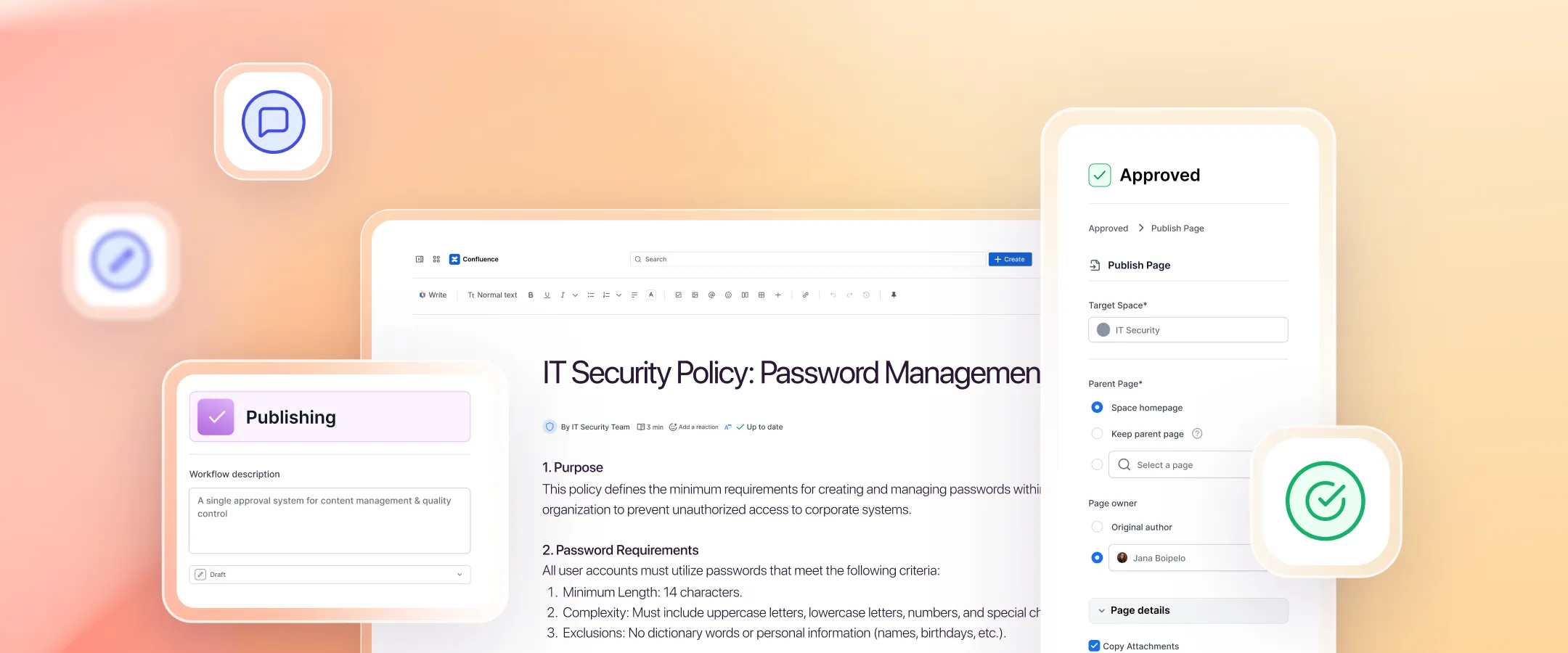
Improve content governance in Confluence with structured approvals and clear ownership. Aura Workflow & Approval brings visibility and control to publishing.
In today’s environment, where your teams are separated geographically, across many time zones and languages, enabling workflow governance that not only ensures work is completed in the proper stages but also doesn’t impede creativity or efficiency, isn’t a simple feat.
Your organization needs a workflow engine that’s dynamic, process-driven, and built to integrate governance into daily operations. Aura Workflow and Approval automates governance, turning it from a bureaucratic blocker into a seamless, built-in process.
The hidden risk: Content without clear ownership or approval
If any of the following processes are in place in your organization, or you’ve been looking to implement something similar in your Confluence instance as part of a content or document management workflow, please continue reading along:
- Multi-step approvals
- Deadline management
- Audit trails and compliance
- Automated notifications
As Confluence usage expands, particularly in the Cloud, the volume of content grows quickly. The problem is that ownership and accountability don’t always keep up. Pages are created, edited, and shared across teams, often without a clear understanding of who is responsible for final approval.
This is where gaps begin to show, and it’s not uncommon to encounter moments like a stakeholder questioning whether a document was ever reviewed, or multiple versions of a “final” content piece circulating among teams simultaneously. Additionally, teams are relying on Slack or Google Chat messages or email threads as proof of approval.
Traditional document management approaches, such as those found in tools like Comala Document Management, attempt to address part of this problem by introducing structured workflows and approval tracking. They bring needed control, including audit trails and configurable approval states.
But as teams scale in Cloud environments, another challenge emerges: usability and visibility. Governance only works if teams actually follow it. If workflows are too complex to manage or difficult to understand at a glance, they risk becoming a bottleneck rather than a solution.
This is where a more intuitive, embedded approach becomes important.
Aura Workflow & Approval addresses this by making approvals part of the natural content flow — visible, easy to follow, and directly tied to how teams already work in Confluence.
What good content governance actually looks like
In short, moving from ad hoc approvals to structured, repeatable workflows is good governance, not adding friction; it’s about creating clarity.
At its core, effective content governance in Confluence includes defining ownership for every piece of content, establishing clear workflow stages (e.g., draft, review, approved, published), providing visibility into where content stands at any given moment, and maintaining a record of who reviewed and approved it.
The challenge is making this repeatable without overburdening your teams, and this is where workflow-driven approaches come into play. With Aura Workflow & Approval, teams can define consistent approval paths that align with how they already work, whether that’s a simple peer review or a multi-step process involving legal, compliance, or leadership.
The result is a system where governance is built into the process, not layered on afterward.
Bringing structure to Confluence, without slowing teams down
One of the biggest concerns teams have about governance is that it will slow them down. In reality, the opposite is often true when workflows are implemented well.
Without structure, however, teams are often chasing the appropriate approvals across a handful of tools, collaborative feedback gets lost or (worse) duplicated, and publishing is delayed due to uncertainty about the correct status of content.
When you embed workflows into your Confluence:
- Approvals are routed automatically via the workflows you create
- Stakeholders know exactly when they are to engage
- Content moves forward with fewer interruptions
While both Aura Workflow & Approval and Comala Document Management support multi-step approvals and role-based involvement, the difference often comes down to how those workflows are experienced day-to-day. Also important to note, Aura combines what Comala typically splits between two separate apps: Comala Document Management for approvals and audit trails, and Comala Publishing for releasing those controlled documents.
And while Comala provides a significant level of control and flexibility, configuring those workflows often requires administrators to define and manage multiple workflow states, transitions, permissions, and approval rules before content can move through the process. For teams that need a straightforward review-and-publish workflow, this additional setup can increase onboarding time and administrative overhead compared to Aura’s guided workflow configuration.
Aura takes a more streamlined approach, enabling teams to configure common approval, review, and publishing workflows through an intuitive interface and guided setup experience. This allows Confluence administrators and content owners to implement governance processes with fewer configuration decisions and less ongoing maintenance, making adoption easier for both technical and non-technical users.
Additionally, Aura is built on Atlassian’s Forge platform, providing customers with the security, compliance, and data residency benefits. As organizations increasingly evaluate Marketplace apps based on cloud architecture and governance requirements, Forge-native architecture can be an important consideration. Neither Comala Document Management nor Comala Publishing is currently a Forge app, which may influence platform and security decisions for some Atlassian Cloud customers.
Aura enables this by integrating directly into the Confluence experience. Instead of leaving the platform to manage approvals, users can initiate, review, and complete workflows where the content already lives. This reduces context switching and creates a more seamless path from draft to published.
How Aura Workflow & Approval supports scalable governance
As organizations grow, governance needs to scale with them. One of the issues being not every team requires the same level of control. That is to say, “one size does not fit all”.
Aura Workflow & Approval allows teams to tailor workflows based on their specific needs. For example:
- A marketing team might implement a lightweight review and approval step before publishing campaign content
- A compliance team may require multi-level approvals with designated roles and strict publishing controls
- A manufacturer could standardize documentation reviews across multiple teams
So while Aura defines a flow that teams can implement, the steps are flexible during configuration rather than hardcoded. Let’s take a look at some of Aura’s key capabilities that enable all three of these scenarios to succeed:
Multi-step approval workflows aligned to real business processes
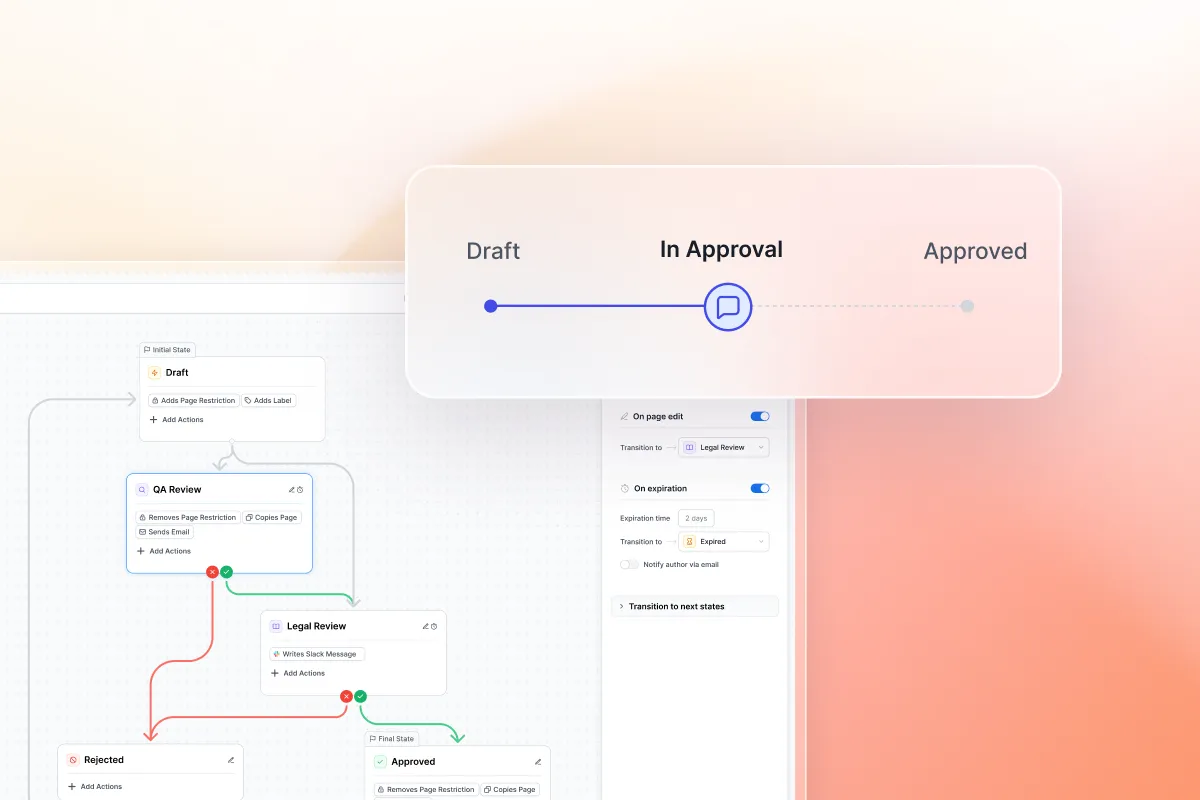
In most organizations, content doesn’t move from draft to published in a single step. It passes through multiple hands, each adding a different layer of validation. A product document might require technical review, then product sign-off. A policy may need legal or compliance approval before it can be shared broadly. Marketing content often moves through brand, messaging, and stakeholder review cycles.
The challenge is that these processes are often managed outside of Confluence, spread across email threads, Slack messages, or informal check-ins. This creates fragmentation. Feedback gets lost, approvals become unclear, and the final version of a document may not reflect the full set of required inputs.
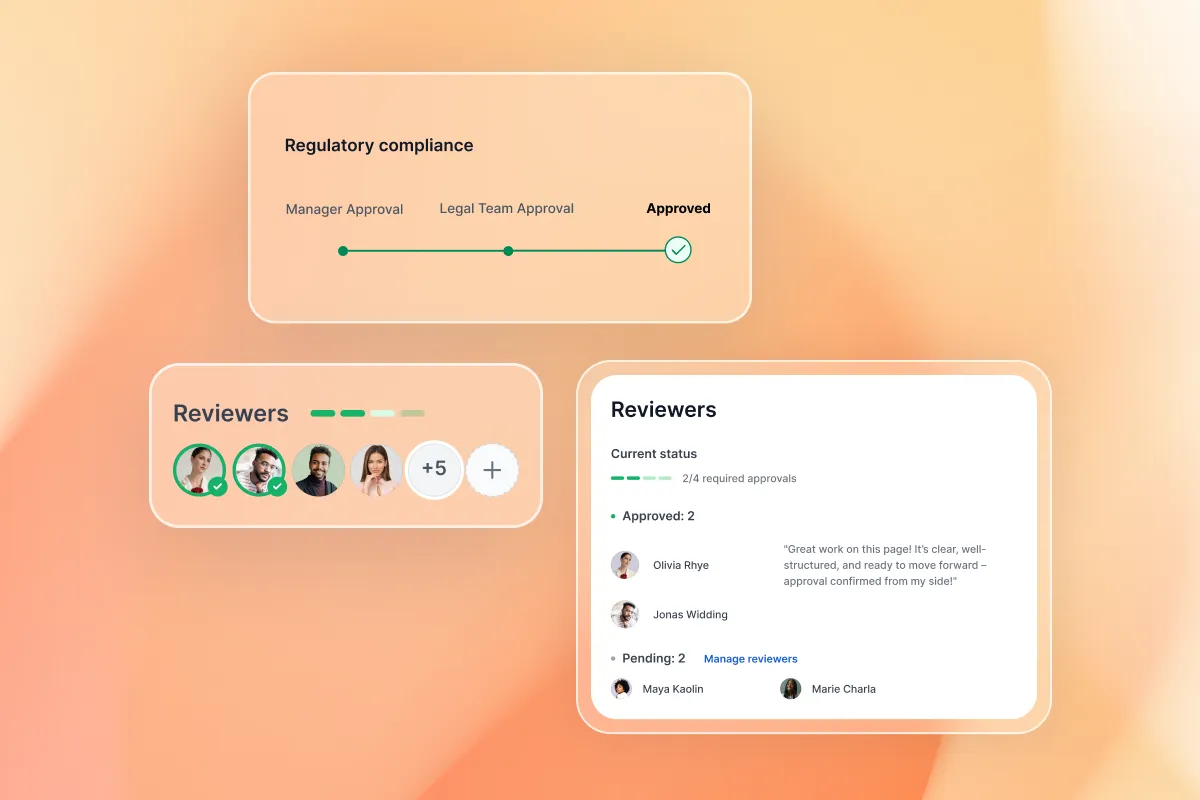
Let’s take a look at an example: a purchase policy page that needs to pass from the creator (author), then to the department manager, then to the legal department (reviewers), and finally to the compliance department (the approver). After completing these steps, the page is published live on your Confluence instance.
Aura Workflow & Approval brings these steps into a single, structured flow that lives alongside the content itself. Instead of asking teams to adapt to a predefined system, it allows workflows to be designed around how the organization already operates. Each stage, from draft, to review, over to compliance, and then off for final approval, can be defined in sequence, creating a clear path from creation to publication.
What makes this particularly effective is that the workflow is visible and understandable. Contributors don’t have to guess what comes next or who needs to be involved. The process is laid out clearly, reducing ambiguity and ensuring that every required step is completed before content moves forward.
Over time, this alignment between workflow and real-world processes creates consistency. Teams begin to follow the same patterns, not because they are enforced externally, but because the system itself reflects how their work naturally progresses.
Role-based approvals to ensure the right stakeholders are involved
One of the most common breakdowns in content governance is not the lack of review, but the inconsistency of it. The right people are not always involved at the right time. Sometimes approvals are delayed because no one is explicitly responsible. Other times, too many people are looped in, creating unnecessary bottlenecks.
Clarity around roles is what resolves this.
Aura Workflow & Approval allows organizations to define reviewers and approvers based on roles rather than individuals. This distinction matters, especially as teams grow or change. Instead of hardcoding workflows to specific people, approvals can be tied to functions, such as “Product Owner,” “Legal” or “Team Lead.”
This approach creates both flexibility and resilience. If someone is unavailable or if team structures shift, the workflow remains intact. Responsibility is clear, but not fragile.
It also improves accountability. When a role is assigned to a step in the workflow, it immediately becomes clear who needs to act next. There is no ambiguity, no need to chase down approvals across different channels. The system itself signals when and where input is required.
At the same time, this doesn’t mean adding unnecessary layers of review. Because workflows can be tailored, teams can decide exactly which roles are needed for each type of content. A lightweight internal document may require only a single reviewer, while a regulated document may involve multiple stakeholders.
The result is a more intentional approach to collaboration, one where the right expertise is applied at the right moment, without introducing unnecessary friction.
Automated status tracking so everyone can see where content stands
One of the most frustrating aspects of content collaboration is the lack of visibility. Without a clear system in place, teams are often left asking the same questions: Is this ready? Has it been approved? Who is reviewing it now?
These questions don’t just slow things down; they introduce risk. Content may be shared before it is fully approved, or delayed simply because no one is sure of its status.
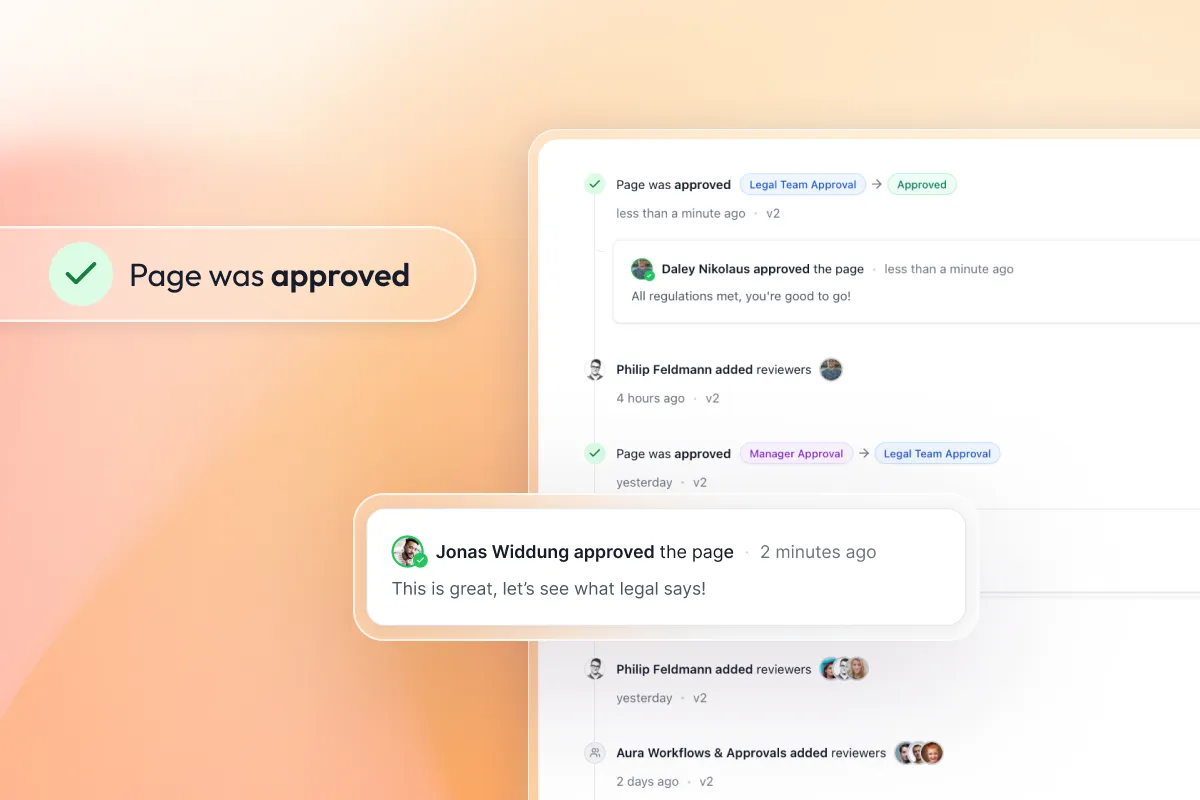
Aura Workflow & Approval addresses this by making the status of each piece of content explicit and continuously updated. As a page moves through its workflow, its current state (draft, in review, approved, or ready to publish) is visible directly within Confluence.
Just as importantly, this status tracking creates a historical record. It becomes possible to look back and see how a document progressed; who reviewed it, when approvals were given, and how long each stage took. This is particularly valuable for organizations that need auditability, but it also benefits any team looking to improve their processes over time.
Teams spend less time on manual coordination and more time focusing on the quality of the content itself.
Controlled publishing permissions to prevent premature or unauthorized releases
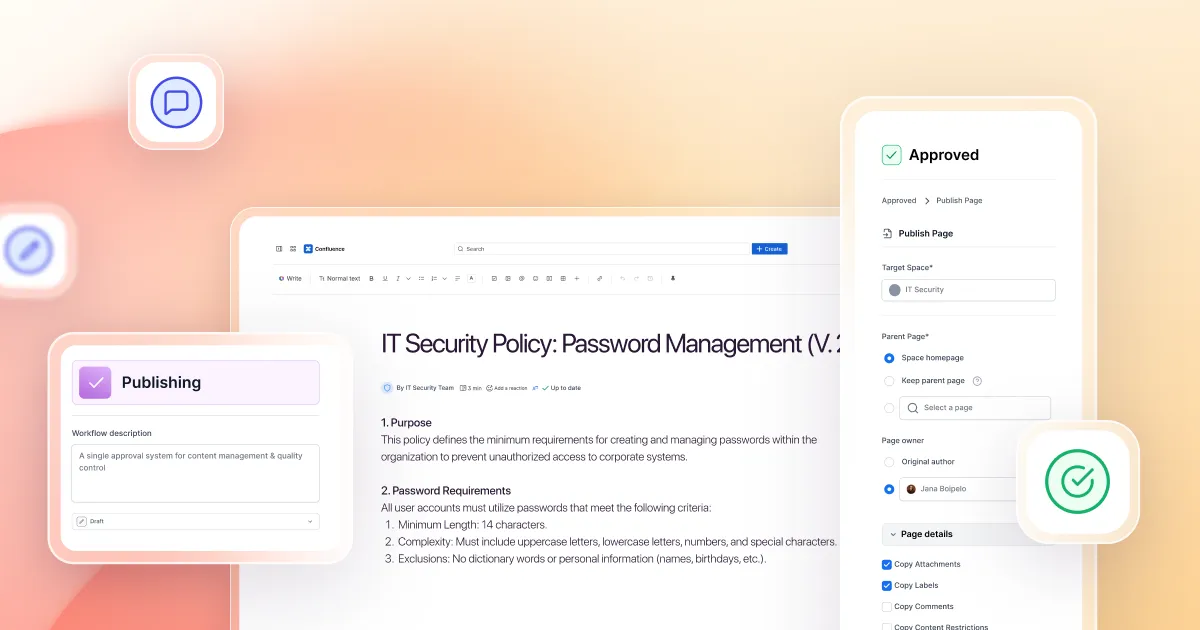
Reaching final approval is only part of the process. In many cases, there is still a gap between a document being approved and its actual publication or accessibility to the intended audience.
This gap often introduces risk. Approved content may sit unpublished, delaying its impact. Alternatively, content may be published prematurely, before all approvals are finalized.
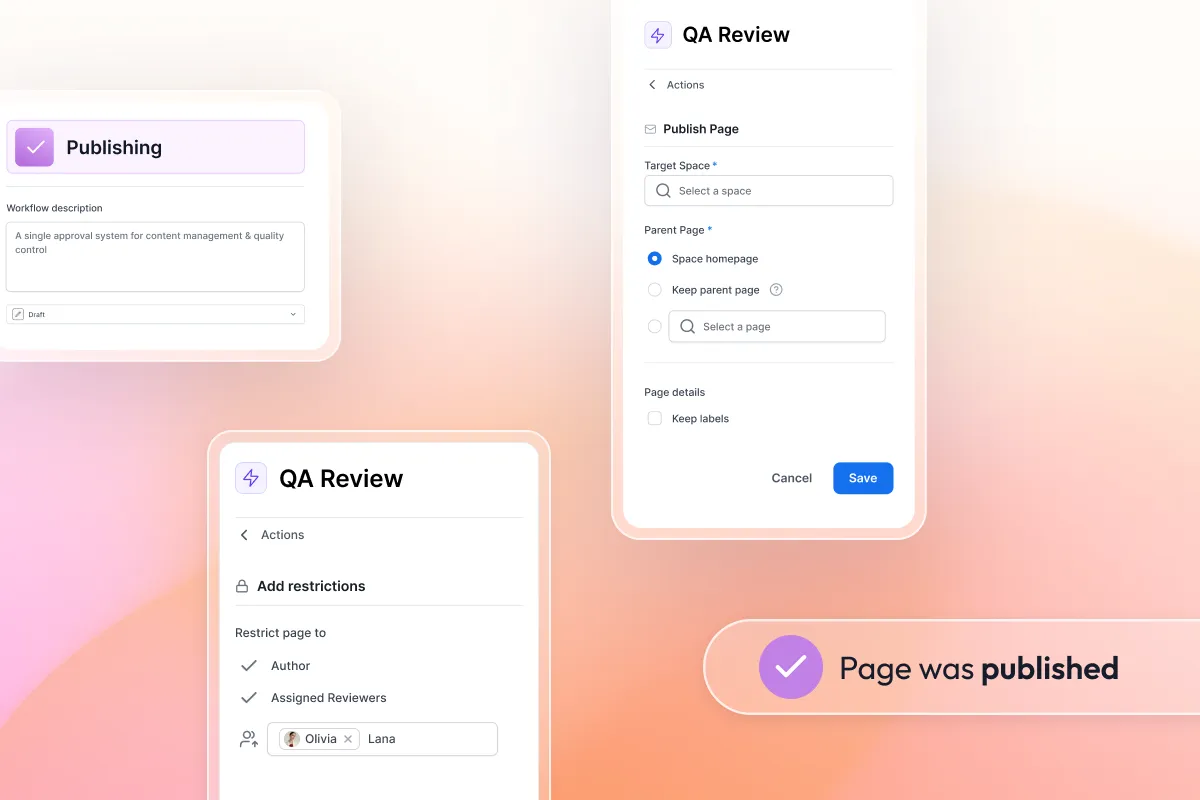
Aura Workflow & Approval closes this gap by automating the final step in the process. Once all required approvals are completed, the system can automatically publish the content according to predefined rules. This might involve changing permissions, moving the page to a different space, or making it visible to a broader audience.
The key benefit here is reliability. Teams no longer need to remember to take a final manual action. There is no risk of forgetting to publish or of publishing too early. The transition from “approved” to “published” becomes a natural extension of the workflow itself.
Practical first steps to improve governance today
Let’s consider some simple ways to start bringing order to your Confluence content.
Improving governance in Confluence doesn’t require a large-scale transformation. In fact, the most effective changes often start small and build momentum over time.
A good starting point is to identify where the lack of structure poses the greatest risk. This is rarely the case on every page in Confluence. More often, it’s a subset of content that carries higher stakes, for example, internal policies, standard operating procedures, or documentation that is shared externally. Focusing on these areas allows teams to introduce governance where it matters most, without slowing down everyday collaboration.
From there, clarity around ownership becomes critical. Every piece of important content should have someone accountable for its accuracy and readiness. Without this, even the best tools and processes will fall short. Put simply, ownership provides the foundation on which workflows can build.
This is where Aura Workflow & Approval becomes particularly valuable. Instead of relying on separate tools or informal communication to manage approvals, teams can embed these steps directly into Confluence. As content moves through its lifecycle, its status is visible, responsibilities are clear, and approvals are captured in context.
What often starts as a small improvement quickly creates a ripple effect. Teams spend less time chasing approvals, stakeholders gain confidence in the content they review, and the overall quality of documentation improves. From there, workflows can be refined, expanded, and adapted as needs evolve.
In closing, control and collaboration can coexist
There’s a common assumption that governance slows teams down, in that adding structure introduces friction and limits flexibility. But in practice, the opposite is often true. When expectations are unclear, work tends to stall. People wait for approvals that were never formally requested.
Feedback loops become fragmented across tools. Content is published with hesitation, or worse, without proper review. What appears to be “freedom” can quickly turn into uncertainty, or more likely, chaos. Clear, well-designed governance removes that uncertainty. It creates a shared understanding of how work gets done, who is responsible at each stage, and what “done” actually means. With that clarity in place, teams can move faster, not slower.
The result is an environment where collaboration and accountability reinforce each other. Teams can create and iterate freely, knowing that the right checks are in place before content is finalized. Stakeholders can trust what they’re reading because the process behind it is visible and consistent.
In the end, effective governance isn’t about restricting how people work. It’s about enabling them to work with confidence, all the while, at speed and at scale!
If you’re ready to bring more clarity, consistency, and confidence to your Confluence content, it may be time to move beyond informal processes. Aura Workflow & Approval helps you turn governance into a natural part of how your teams work, without slowing them down. See how it fits with the rest of our Governance solution for Confluence, or explore the full feature set on the Atlassian Marketplace.